Showing posts with label garden. Show all posts
Showing posts with label garden. Show all posts
Friday, March 7, 2014
Garden Bloggers Bloom Day December 2011
 |
| Nandina domestica (Heavenly Bamboo) berries |
 |
| Picea pungens Montgomery Globe Spruce |
 |
| Chamaecyparis pisifera Gold Mop |
 |
| Ajuga Burgundy Glow (Left) and Golden Sedge (Right) |
Seen here is the Burgundy Glow Ajuga that I just planted this year next to Golden Sedge. Ajuga has been stubborn in my gardens in the past but this year it has really taken off. I finally found the perfect spot for it in dappled shade and with northeastern exposure.
 |
Weeping Blue Atlas Cedar with Barberry (Right) and Gold Mop Cypress (Left) |
Here is the Weeping Blue Atlas Cedar that has had much growth this summer. In the backdrop is Cryptomeria japonica Angelica along with Gold Mop Cypress (left) and Barberry Rosy Glow (right). The Barberry is starting to form some of its vibrant red berries that look beautiful throughout winter.
 |
| Berries on Upright Japanese Holly Chesapeake |
At this time of year the Chesapeake hollies produce clusters of plump black berries. I really enjoy this added December interest in the garden...so much fun! The vibrant red berries of Nandina domestica (photo above) are also a sight to behold!
 |
| Crape Myrtle Seed Heads |
This Crape Myrtle is one of my favorite trees in the garden. It even draws interest in winter with its spent blooms and interesting seed heads. When the blossoms fade clusters of greenish berries darken as they dry out. These seed heads attract birds to the winter landscape and provide a welcomed food source for our feathered friends.
 |
| Stachys (Lambs Ear) |
The Lambs Ear is still looking good even in December.This plant is just amazing in that its foliage really adds interest for many months throughout the year.
These are the moss rock boulders that I added for some impact last summer. I am really enjoying the dimension that they add to the garden. Soon the winter snow will cover them to add some additional interest.
 |
| Dwarf Mugo Pine Against Weeping Blue Atlas Cedar and Moss Rock |
 |
| Blue Atlas Cedar |
 |
| December Sky |
I hope you enjoyed the tour of my December garden. Please visit Carol at May Dreams Gardens for more December blooms around the world.
"Nature has undoubtedly mastered the art of winter gardening and even the most experienced gardener can learn from the unrestrained beauty around them." ~Vincent A. Simeone ("Wonders of the Winter Landscape")
"The gardening season officially begins on January 1st, and ends on December 31."
- Marie Huston As Always... Happy Gardening and a Happy GBBD!
Author: Lee @A Guide To Northeastern Gardening Copyright 2011. All Rights Reserved.


Tuesday, March 4, 2014
Cleaning Up The Garden
Pope Gregory XIII must have lived in Durban at some point when he invented the modern day calendar and assigned only 28 days to February. In Durban its the hottest, most humid month and thankfully there are only 28 days to get through! Unfortunately, for obvious reasons its also the busiest time of the year for us gardeners - the combination of the heat and rain means that you can almost literally watch the plants grow. Its also the time of the year when I appreciate how important good garden maintenance is to the success of any landscape project.
Its quite demoralizing coming back to a garden years later to find that the basic garden care hasnt been done and even in some cases finding that weeds have totally usurped the planting. Often, branches have grown out further than they should have, and the grass below has died. Regular composting has been neglected. The real value of the garden has all but been lost.
Garden Care has been on my mind a lot lately because we are in the process of turning over a new leaf in our business (please excuse the lame but apt pun).
For years, my focus has been on the landscaping aspect of our business. Creating gardens has always been my real passion and unfortunately, like a garden thats been left untended, the Garden Care aspect of the business hasnt had the attention it deserves.
For the last few months, Ive been trying to revitalize the Garden Care component of our business. Like a real garden though, its been a difficult process. There have been some things we have had to prune right back, and still other areas weve had to replant entirely. Ive been confronted with my limitations and insecurities - all good but painful realisations.
I have finally appointed a Manager to oversee all the maintenance functions of the business - someone who has all the skills and abilities I dont. Whod have thought cleaning up, and letting go of the things you dont do well would be such a hard thing to do? Or maybe Im just dense...
Its amazing though, how much better you feel when you clean things up. Im looking forward to being more focused on the things I do well, and letting go of the things I dont. Its time to wear less hats around here. Talking of which, I better put my hat on and get back into the heat...
Read More..
 |
| Sometimes a little wildness is good - a garden we did about 12 years ago reflecting off the pool |
Garden Care has been on my mind a lot lately because we are in the process of turning over a new leaf in our business (please excuse the lame but apt pun).
For years, my focus has been on the landscaping aspect of our business. Creating gardens has always been my real passion and unfortunately, like a garden thats been left untended, the Garden Care aspect of the business hasnt had the attention it deserves.
For the last few months, Ive been trying to revitalize the Garden Care component of our business. Like a real garden though, its been a difficult process. There have been some things we have had to prune right back, and still other areas weve had to replant entirely. Ive been confronted with my limitations and insecurities - all good but painful realisations.
I have finally appointed a Manager to oversee all the maintenance functions of the business - someone who has all the skills and abilities I dont. Whod have thought cleaning up, and letting go of the things you dont do well would be such a hard thing to do? Or maybe Im just dense...
Its amazing though, how much better you feel when you clean things up. Im looking forward to being more focused on the things I do well, and letting go of the things I dont. Its time to wear less hats around here. Talking of which, I better put my hat on and get back into the heat...
Monday, March 3, 2014
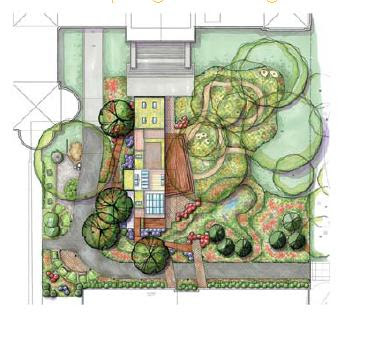
Pleasure Garden

Thoughts about our garden.
“We desire,” the Emporer dictated, “that in the garden there should be all kinds of plants.” Charlemagne the Great

I do a lot of writing about gardens, but our own personal garden has never been the subject of this blog. Our garden is always a backdrop to my thinking about gardens and gardening—a sort of character in my story whose face is never revealed. There are many reasons for this: first, our garden is just in the process of being established; I’m a terrible photographer and our garden is surrounded on three sides by unattractive roads and on one side by our unattractive house; and mostly because the act of gardening feels profoundly personal to me. It was designed for us, for our own pleasure, so the idea of opening for public consumption is a bit terrifying to me.
 |
| BEFORE: The garden area when we bought the house. |
But I love other blogs that openly share their own gardens. James Golden’s View from Federal Twist is a brilliant blog about two wonderful gardens. That James bears his own soul through the garden is a source of endless inspiration to me. I’m just not that brave. And Scott Weber’s Rhone Street Garden is another fantastic blog. Scott transforms his small garden into and endless expanse through the lens of his camera. Through his images, I see and enjoy Scott’s garden much in the way he probably does.
 |
| Nasella tenuissima and Salvia Caradonna |
So in homage to other bloggers who bravely open their own gardens to public scrutiny, I am adding a few images of our own “in-process” garden. This spring marks two full years since I began smothering a triangular wedge of lawn in our sunny side yard. This area was too small to be a usable lawn, and too close to the road to be an enjoyable outdoor use area, so it seemed like a practical area for a garden.
 |
| The sipping terrace which my brother-in-law calls the "duck blind" in late summer |
The house we bought was a neglected mid-century ranch which we essentially gutted, so my wife and I have poured our resources and time into renovating the house room by room. The only way to afford the renovation was to do everything ourselves, so that has left little time and money for the garden. The assembly of plants—and assembly is a much more accurate term than design—is a result of what we could get cheaply, what we could divide, what was available, and what would survive the mid-summer heat and humidity. This approach is probably entirely familiar to most gardeners, yet entirely problematic from my point of view as a designer. The garden becomes a product of impulse purchases and ad hoc decisions, not careful planning.
 |
| Kniphofia Salleys Comet with Pleioblastus viridistriatus, Nepeta "Walkers Low and Eschscholzia californica |
But I’ve decided to embrace this non-designed approach. Design has its limitations, too. Any designer who has ever installed a garden, walked away, and then visited that garden five years later learns that design is not a singular vision set to paper; design is a thousand of little decisions and actions made through the life of the garden.
 |
| Iris Persian Berry, one of the most exquisite colors Ive ever seen |
With no real design to speak of, the garden has only a sort of guiding philosophy: plant only that which gives us pleasure. To use an admittedly pretentious term, our garden is a sort of “pleasaunce” by default, an archaic term for pleasure-garden. The concept of a pleasure garden is a bit antiquated these days. We are now much more likely to call non-food bearing gardens ornamental gardens. But “ornamental” is such a poor descriptive phrase. Who picks plants like they would pick wallpaper? To match their exterior trim? The worst gardens are those that aim to be merely decorative. No, we pick plants to live with us because they give us pleasure. I was recently re-acquainted with the idea of pleasure gardens when I re-read one of my favorite garden books, Rose Standish Nichols’ English Pleasure Gardens. It is a book I often pick up, read a chapter, and then put it away for a while. This century-old book is a compelling story of the English garden as viewed through three centuries of garden history. Throughout the book, one theme keeps emerging throughout the millennia: gardens exist for our pleasure.
Christopher Lloyd’s writings have also been an inspiration of late. Perhaps I’ve spent too many years designing gardens, too many years of balancing client’s desires with safe plant selections. I love the almost garish quality of Dixter’s Long Border. The way it thumbs its nose at “tasteful” gray, pink, and blue color harmonies. The way it mixes tropicals, shrubs, perennials into one boisterous expression. Like Dixter, I would love a garden dedicated to nothing but horticultural craftsmanship. Beware of harboring too many plants in your garden of which the adjectives graceful and charming perpetually spring to your besotted lips, Lloyd warns as he clutches a black-leafed Canna. I love that. Dixter’s great triumph (and perhaps its downfall) is that it employs every tool in the planter’s toolkit all at once. The result is a hot mess, but one of the purest expressions of horticultural exuberance I’ve ever known. And what a joy that is.
 |
| Cotinus Royal Purple center (coppiced yearly), Savlia sclarea, Miscanthus Morning Light and Alliums |
Perhaps all gardening is an attempt to re-create Eden, but our garden has absolutely no paradisiacal qualities. As a result of its placement next to an ugly house and an ugly road, we’ve adopted a more postlapsarian style. In the border, we have an ecumenical selection of wetland plants, desert grasses, South African bulbs, native forbs, and color foliage shrubs. Anything goes as long as it goes. The other side of our yard, we are beginning another more restrained garden evocative of a woodland edge. But in the border, there is no room for restraint, only more and more plants.
 |
| Nasella tenuissima, Salvia Caradonna and Allium Purple Sensation |
In this blog, I am often guilty of heaping too much meaning on gardens, burying a simple act under too many metaphors. Perhaps it is an effort to justify my own profession, to add more significance to my calling than actually exists. If a garden exists simply for our own pleasure, what then? Perhaps that is enough. All I know is that gardening is hard work that reveals many agonies and few ecstasies. So despite the garden’s many flaws and failings, when the afternoon sun hits a patch of Feather grass and silhouettes the violet stems of Salvia ‘Caradonna’, it is enough for me. For now, I am pleased.
 |
| Phlomis tuberosa and Hibiscus Fantasia |
 |
| The ever ubiquitious, but entirely useful Spiraea Goldflamme with Zahara Zinnias |
 |
| Our native-ish garden, planted this srping. |
Subscribe to:
Posts (Atom)